
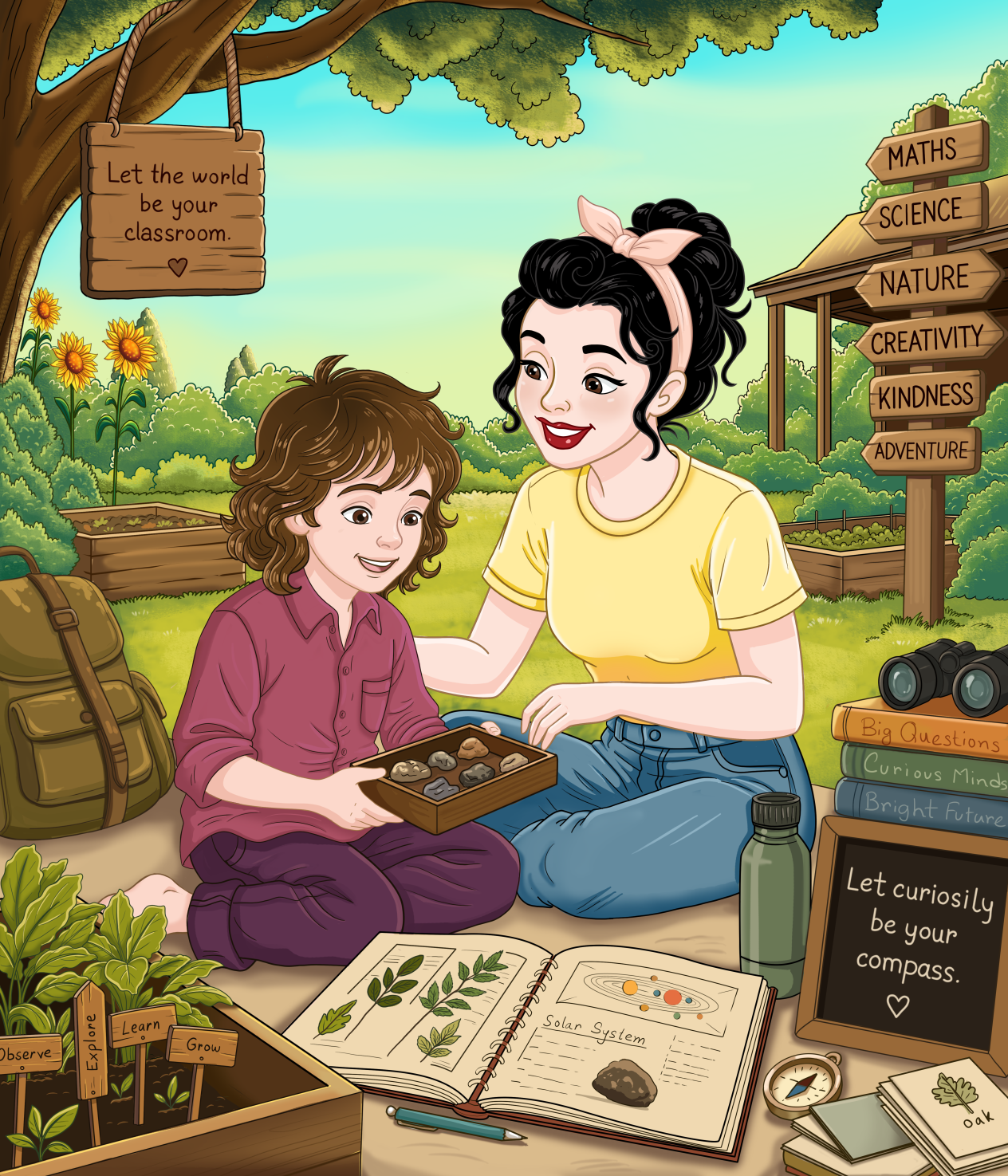
Homeschooling wasn’t part of our plan. In fact, when we first started, it was supposed to be temporary. We were in the middle of a big transition, and homeschooling was going to be the thing we did for a few months while we moved interstate. And then something rather unexpected happened.
I fell in love with it. Not because every day is blissful. Not because we spend our days sitting around the kitchen table doing perfect little lessons. And definitely not because I suddenly became some kind of Pinterest homeschooling mum with colour-coded baskets and a laminator.
What I discovered was something much more interesting. When you remove the assumption that a child has to learn in a particular place, at a particular pace, in a particular way, you suddenly have an enormous amount of freedom.
You can actually ask: “What does this child need right now?” Then build the day around that. And what a gift that can be for a child.
So today, on I Love Me The Podcast, I want to take you inside our homeschooling experience. Why we chose it. What I’ve learned. What surprised me. And why I believe homeschooling can be such a psychologically nourishing option for children. Because what I’ve discovered through my own experience, and those of the homeschooling families I meet, is that:
Children thrive when their environment is able to meet them where they actually are.
Simple, inspiring lessons in self-love. Hello beautiful, it’s Tamra here.
Now, before I get into the story, I want to make something really clear.
This is not an episode about how terrible schools are.
Because I don’t believe that.
There are some extraordinary teachers and schools doing beautiful work with children.
My son had some wonderful teachers who’ve supported him in amazing ways during the two and half years he spent at school.
And school can be the right environment for some children, or at some points in a child’s journey.
This is simply my story.
And what our family discovered when we started looking at education through a slightly different lens.
Because, to be completely honest, I feel there was always a little part of me that wanted to homeschool.
But when you live in a society where school is simply considered what children do…
It can be really difficult to imagine anything else.
School is the default.
You go to school.
You learn in a classroom.
You sit with children your own age.
You follow the curriculum.
You get your reports.
You move up a year.
And eventually you graduate.
Simple.
Except…
Children aren’t simple.
They are wildly individual.
And that was something we started to see very clearly with my son, Zen.
When he was four, he had a formal assessment which found that academically he was functioning around six years ahead of his expected level.
He began reading in both English and French at around 20 months old.
And what that showed us very early on, was that Zen was going to need an educational environment that could meet him where he was.
Because every child is different.
Some children need more challenge.
Some need more time.
Some need more movement.
Some need more support.
Some learn through reading, others through doing, creating, talking, moving or being out in nature.
And when a child’s needs sit outside what is considered ‘average’, it can become much harder for a standardised environment to consistently meet those needs.
And that, really, is what this episode is about.
Not creating the ‘perfect’ educational environment.
But creating an environment where your child has the best opportunity to thrive.
For Zen, school was still enjoyable.
He had friends.
He loved aspects of it.
He’s the kind kid who finds the juice in almost any situation!
So we were lucky in that regard.
He wasn’t sitting there miserable every day begging me to take him home.
That said, he did regularly tell me that he thought homechooling would be a better option.
Despite various attempts to extend and accelerate my son, and him attending two very different schools, carefully selected by myself and my husband, it was difficult for the schools to consistently meet his academic needs.
And that created a really interesting situation.
Because a child can be generally happy at school, but feel like something’s missing.
Or, which I know has been the case for many of the homeschooling families I’ve met, school has just been the wrong fit, and has ended up creating trauma for those children.
Eventually, we decided we were going to move interstate and planned to homeschool for a short period while we did the move, with the intention to move Zen to a Japanese bi-lingual school, as the French bi-lingual school he’d been at, had extended him reasonably well the first year he was there.
Then, unexpectedly, we started homeschooling a little earlier than planned.
And honestly?
Thank goodness we did.
Because that little accidental experiment completely changed my perspective.
We got to experience homeschooling before committing to another school.
And somewhere along the way I thought…
Oh.
This actually works.
Really, really well.
And this is where homeschooling gets fascinating.
Because suddenly education isn’t:
“What should a Year 4 child be doing?”
It becomes:
“What does this child need?”
And that question changes everything.
If he’s flying through something, we can keep going.
If something needs more time, we can slow down.
If he’s inspired by something, we can follow the inspiration… and go down a millon rabbit holes.
If he’s tired, we can rest.
If he needs movement, we get outside and we move, or have a 5-mintue dance break like I share in Episode 83.
If he’s emotional, we can stop and sit with the emotion rather than trying to squeeze it into a timetable.
And sometimes…
We just ditch all the academic stuff.
And we knit, or do crosstsitch.
Play with worms in his worm farm, which he built as part of our Permaculture studies.
Or go for a bushwalk.
And you know what?
Life is still happening.
Learning hasn’t stopped.
It’s simply changed shape.
It’s giving him exactly what he needs in that moment, to not only satisfy his emotional needs, but his educational needs.
Because learning’s happening all the time.
Be it in a less structured, but more present way.
Because its worth saying, when we homeschool, we’re not trying to mimic what happens in the classroom at school.
We’re offering a child a different educational experience.
One that’s more fluid.
When Zen finds himself in emotion, because we’re homeschooling we have time be with the emotion.
I can hold space for him to move through it, so that in the future, he better understands how to work with emotions.
Because if there’s one skill most adults are lacking, it’s the inability to move through their emotions in a healthy way.
And this is because emotional regulation doesn’t get a lot of air time in most schools.
But as homeschooling parents, we have this wonderful freedom where we can pause.
We can support.
We can adapt the learning needs to that particular situation in time.
Because when a big emotion arises, it’s usually because the child has been stretched in a way that feels uncomfortable.
And taking the time to unpack that, will free that child of old traumas or conditioning or experiences that might have held them back in their learning.
And I love that.
Another thing I’ve noticed, is how much more space there is for ‘play’.
At school, children have limited breaks, and those breaks have all sorts of practical things packed into them.
Eat lunch.
Go to the toilet.
Get outside.
Socialise.
And then…
Back to class.
Often within a 30-minute time window.
Homeschooling, Zen can have a three-hour playdate.
And I don’t have to interrupt it because the bell rang.
They can disappear into some elaborate imaginary world and build something ridiculous and argue about the rules and negotiate and create and solve problems.
And that is learning.
Research on ‘play’ consistently points to its importance for children’s cognitive, social and emotional development.
It also helps them process their emotions.
Which brings me to a concern most people have around homeschooling:
Socialisation.
Despite the worries that kids will miss out on valuable time with peers, this is rarely the case.
Reviews have found that in general, home-educated children have social outcomes comparable to, and usually better than, their traditionally schooled peers.
I’ve heard multiple university teachers saying:
You can tell the homeschooled kids from the kids who went to school, because they’re more creative, have more autonomy and are more socially confident, especially when interacting with their teachers.
And I can certainly say from our experience…
My child is not short on socialisation.
If anything, he has more opportunities now.
We’re regularly out with homeschool groups.
He has playdates.
He has stronger friendships.
He takes lessons with different teachers.
He volunteers.
He sings in a cathedral choir.
He connects with a regular bunch of kids at his ninja warrior classes — in fact, the class only goes for 45 minutes, but we never leave before 3-hours has passed, as he’s too busy playing.
Zen attends all sorts of different activities.
And one of the things I really love is that his social world isn’t limited to 25 children who happen to have been born within twelve months of him.
He gets to interact with younger children.
Older children.
Teenagers.
Adults.
Teachers.
Shopkeepers.
Customers.
People in the community.
Real life.
And this is where I feel mixed-age socialisation is such a positive element of homeschooling.
Children can learn a tremendous amount from people who are at different developmental stages.
Younger children can learn by watching and participating alongside older children.
Older children get opportunities to explain, help, lead and care for younger ones.
And everyone gets to experience something really important:
You don’t always have to be the one who knows.
And you don’t always have to be the one who needs help.
Sometimes you’re the learner.
Sometimes you’re the teacher.
Sometimes you’re the person who needs support.
And sometimes you’re the person who gets to offer it.
And honestly, think about adulthood.
Do you only socialise with people who were born in the same year as you?
Of course not.
We live in communities.
We have neighbours who are older than us.
Friends who are younger than us.
Colleagues at completely different stages of life.
Grandparents. Babies. Teenagers.
People who are brilliant at things we’re terrible at, and people who need our help with things that come naturally to us.
That’s real life.
Yet we often create these very artificial social worlds for children where everyone is almost exactly the same age, expected to be at roughly the same developmental level, doing roughly the same things, at roughly the same time.
And I think there’s something incredibly valuable about giving children opportunities to experience something different.
Because when you’re constantly surrounded by children your same age, it’s very easy for difference to become comparison.
Who’s ahead?
Who’s behind?
Who’s better at maths?
Who’s faster?
Who’s more popular?
But when you’re in a genuinely mixed community, difference can simply become… difference.
A five-year-old might be brilliant at something an eight-year-old isn’t.
An eight-year-old might be able to teach something to a five-year-old.
A twelve-year-old might introduce both of them to something completely new.
And suddenly, the question isn’t:
“Where do I rank?”
It’s:
“What can we learn from each other?”
And to me, that’s a much healthier foundation for social development.
Because ultimately, we aren’t raising children to spend their adult lives surrounded by people exactly like them.
We’re raising them to participate in the world.
To communicate with different kinds of people.
To cooperate.
To contribute.
To ask for help.
To offer help.
To navigate difference.
And to understand that their value doesn’t depend on being the best person in the room, or the most popular.
That’s the kind of socialisation I want for my child.
Another thing I’ve really come to appreciate through homeschooling is just how important our relationship with our children actually is.
There’s a book by Gabor Maté and Gordon Neufeld called Hold On to Your Kids, and one of the ideas they explore is what they call ‘peer orientation’.
Essentially, the concern is that as children get older, they can start looking more and more to their peers for their sense of belonging, identity and direction, rather than looking to the adults who are actually there to guide them.
And I think this is especially interesting when we think about the teenage years.
Because of course our children need friends.
Of course they need other children.
Of course they need to develop their own relationships and independence.
That’s all healthy.
But the idea is that:
Our relationship with them needs to remain strong enough that we still matter.
That when they’re confused, they can talk to us.
When something goes wrong, they can come to us.
When they’re trying to work out who they are, they still feel safe enough to let us into that process.
And homeschooling has given me an enormous amount of time to build that relationship.
Not just teaching my child.
But knowing my child.
Knowing what makes him light up.
Knowing when he’s tired, or overwhelmed.
Knowing when he needs a cuddle, because something’s bothering him, but he hasn’t found the words yet to explain what that is.
Being there for the little moments that might otherwise get lost in the busyness of the day.
And I think there’s something really powerful about that.
Because ultimately, our children don’t just need an education.
They need somewhere safe to belong while they’re figuring out who they are.
Now homeschooling doesn’t just benefit the child.
And this is the part that can be a little unexpected for parents.
Because while you think you’re homeschooling your child, your child will inevitably start homeschooling you.
What I mean by that is, when you spend this much time together, your child has a funny way of showing you all the places where you still have room to grow.
All those little places where you want to control things.
Where you’re rushing.
Where you’re trying to fit too much in.
Where you’ve decided there is a right way something should be done.
And suddenly, your child is standing there, completely unconcerned with your carefully constructed plan for the day, while you’re having a minor existential crisis over why they don’t want to do maths at 10:17am.
For me, homeschooling has been a huge lesson in releasing control.
In slowing down.
In not trying to cram 47 things into one day.
In allowing life to unfold a little more organically.
And perhaps most unexpectedly, it’s made me look very closely at my own beliefs around productivity and worth.
Because when you reduce your paid work to homeschool your child, some really interesting questions can come up.
Who am I if I’m not being productive?
What makes me valuable if I’m not earning money?
Can I trust that what I’m doing matters, even when there isn’t a pay cheque at the end of it?
And those questions are mine to work through.
They’re not my child’s problem to solve.
But homeschooling has given me the space to actually see them.
And that’s one of the things I’ve come to love about this experience.
Because I think homeschooling can become a surprisingly deep spiritual practice.
Not because you’re sitting around doing yoga and lighting candles while your child peacefully completes their mathematics.
But because your child becomes a mirror.
They show you where you’re still holding on too tightly.
Where your patience runs out.
Where you’re trying to control the outcome.
Where you’re carrying expectations that perhaps don’t even belong to you.
Where you’re asking your child to regulate something that you’re still learning to regulate within yourself.
And when you’re spending this much time together, there really isn’t anywhere to hide.
But honestly?
What a gift.
Because every time my child shows me something I still need to work on, I have an opportunity to meet that part of myself with a little more awareness, compassion and love.
And the more whole I become, the more whole I can be with my child.
The more regulated I become, the more safely I can hold space for his emotions.
The more I learn to let go of control, the more freedom I can give him to become himself.
So if you’re up for the challange…
Homeschooling can become an education in becoming a better version of yourself.
And this is something I talk about much more deeply in Episode 7: Use Your Relationships To Grow Your Self-Love, because our closest relationships have an extraordinary way of showing us exactly where we still have some inner stuff that needs resolution.
Next, we have the sheer freedom that homeschooling allows.
Zen wanted to learn about business and earn his own money.
So we created a little pet-care business together.
He’s learning about animals, communication, responsibility, money and investing.
He wanted to learn more about music?
Fantastic.
He sings in a cathedral choir and is learning from highly experienced musicians.
He loves languages and after becoming confident in French, wanted to move onto Japanese, because the characters looked so fun!
And he likes Sushi and Pokemon.
So after learning the basics together, I booked him into Japanese lessons to deepen into the places that I cannot take him myself as I’m not a native Japanese speaker.
He wants to understand something complicated?
We go down the rabbit hole.
He needs more physical development?
We climb, swim, play soccer, do yoga, dance, or simply get outside and run!
And this is one of the things I love most about homeschooling.
Education can become a ‘life’ rather than a ‘place’.
Now, homeschooling isn’t easy.
Let’s not put glitter on it.
Some days are chaotic.
Some days I need to devour a big block of dark chocolate to sooth my nerves — that only happened once!
But then I look at my child.
And I see him thriving.
I see his confidence.
I see his curiosity.
I see him forming beautiful friendships.
I see him tackling things that challenge him without immediately deciding he can’t do them.
I see him developing physically.
Emotionally.
Intellectually.
Socially.
And I think…
Yes.
This is why we do it.
Not because homeschooling is superior.
But because this environment is working for this child.
And perhaps that’s the bigger conversation I’d love us to have.
Instead of asking:
“Is school better than homeschooling?”
Maybe we ask:
“What environment allows this particular child to thrive?”
Because every child is different.
And maybe education doesn’t need to be about fitting the child into the system.
Perhaps sometimes, we can build the system around the child.
So if you’ve been quietly wondering whether homeschooling could be right for your family, I hope this episode has helped you see that it doesn’t necessarily mean sitting at a desk in your dining room from nine ’til three.
It can be wonderfully messy.
It can be beautifully flexible.
It can be social — I am more social than I’ve ever been!
It can be outdoors.
I do as much outside learning as the weather allows.
It can involve music, sport, business, nature, community, friendships, sewing, books, adventures and an extraordinary amount of learning that doesn’t look anything like school.
But most importantly…
It can give you the space to really know your child.
To discover how they learn.
What excites them.
What challenges them.
What they need.
And who they’re becoming.
Because our children aren’t projects that need to be completed.
They’re human beings unfolding.
And perhaps one of the greatest gifts we can give them is an environment spacious enough for that unfolding to happen naturally.
Not perfectly.
Not according to someone else’s timeline.
But in their own beautifully unique way.
So that’s why I homeschool.
Not because I think I’ve found the perfect way to educate a child.
But because I’ve found an environment in which my child is thriving.
And for me, that’s perfect!
And if you’re sitting there thinking:
“Okay, but how on earth do you make this work financially?”
… I’ve got you.
I’ve popped a link in the show notes to a blog I just wrote called Homeschooling On A Shoestring, because homeschooling really doesn’t have to cost a fortune.
Yes, there are endless classes, tutors and activities you could spend money on.
But there are also so many incredible opportunities that cost very little, or even nothing at all.
In our experience, we’ve been able to access wonderful teachers, activities and real-world experiences for less than $30 a week.
So if you’re curious about how to build a rich, varied homeschooling life without emptying your bank account, have a little look at Homeschooling On A Shoestring in the show notes.
Because you really can give your child a pretty extraordinary education without needing an extraordinary budget.
If this episode landed for you, please share it with another parent who might be quietly wondering whether there could be another way.
Because sometimes the biggest changes in our lives begin with a very simple question:
“What if we did this differently?”
Big love, gorgeous.
And I’ll see you in the next episode.