
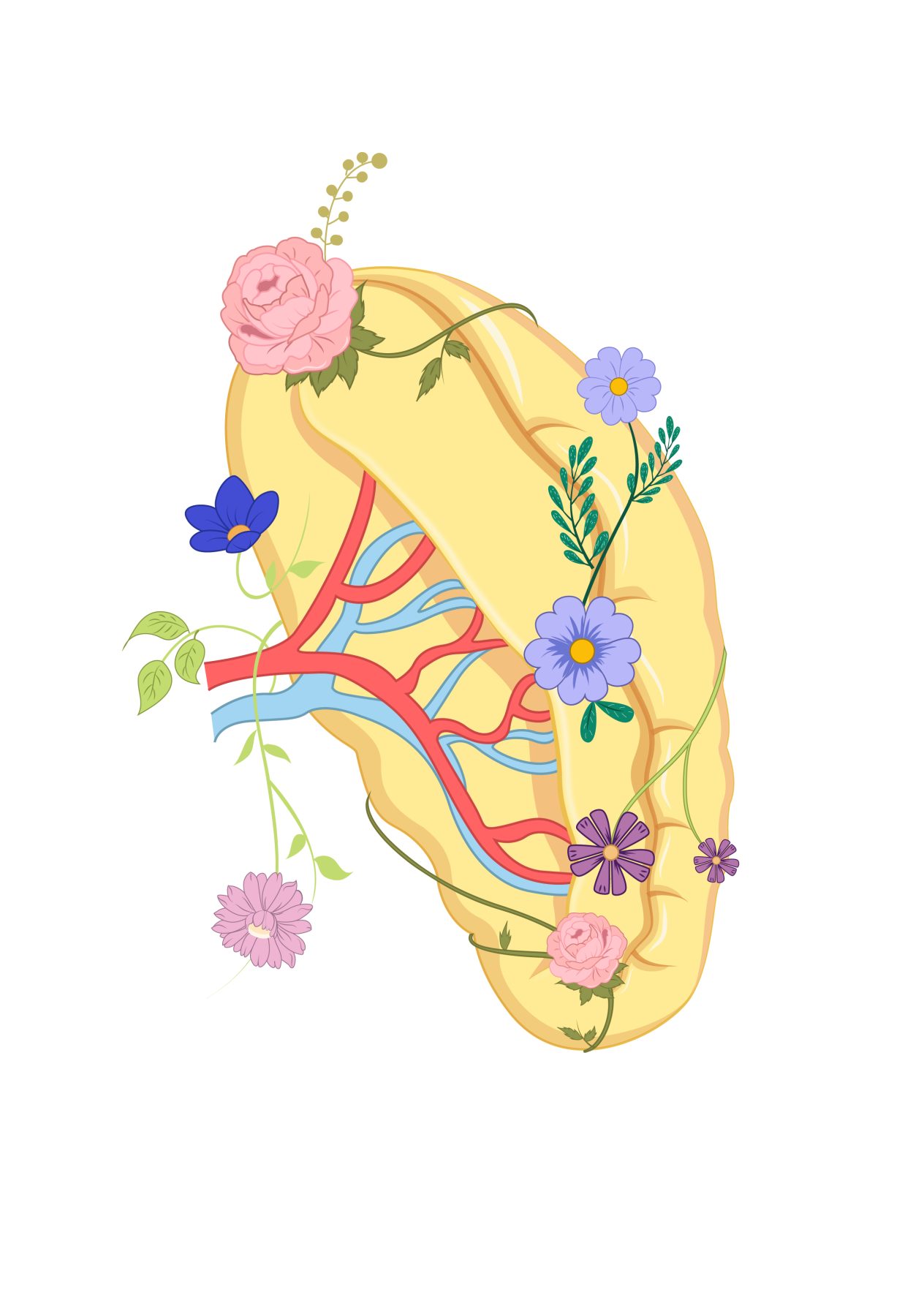
Imagine returning to the very centre of yourself — that’s where Late Summer invites us. Here in the Southern Hemisphere, we’re stepping into the season of Late Summer. In Traditional Chinese Medicine, this is the home of the Earth Element; the season where our Spleen awakens.
Now, if you’ve never really thought much about your Spleen, this episode on I Love Me The Podcast, will help you understand why it’s so important, and how it touches every area of our life. I’ll be sharing the role the Spleen plays in our energy, our digestion, our mental clarity, and our inner sense of safety. And the beautiful thing is:
Once you understand this system, you’ll start to understand yourself.
Simple, inspiring lessons in self-love. Hello sunshine. It’s Tamra here.
In case you’re wondering, your Spleen is located on the left side of your abdomen, tucked up under your rib cage.
You might like to place your hand on that area now, to get a felt sense of where it is.
But when we talk about the Spleen in Chinese Medicine, we’re not just talking about an organ that sits quietly inside you.
We’re talking about the part of you that digests everything — not just the food you eat, but the thoughts you think, the emotions you carry, the life events and circumstances you experience.
Because the health of our Spleen influences all of these things, including the mind.
For when our Spleen is happy, our mind is focused.
Yet when our Spleen is tired, our mind keeps replaying the same thoughts, we keep repeating the same patterns in life, we worry…
You know those times when your thoughts feel thick or muddy?
Or when you keep circling the same idea, chewing it like a cow in a paddock?
That’s the Spleen saying:
“Hey… I’m overwhelmed. I need gentleness. I need grounding. I need space.”
But the Spleen doesn’t work alone.
It’s Yang partner, is the Stomach.
And these two organ systems work together, to support us in staying healthy and well-balanced through Late Summer.
Now Late Summer as a season is not something we westerners usually consider a ‘season’.
But in Chinese Medicine, this is an energetically powerful season, as its the moment between the outwardness of Summer and the inwardness of Autumn.
Spring and Summer are both Yang seasons; where things are growing, the days are getting longer, we’re doing more and, if aligned with the season, we’ll have more energy to be out there.
On the flip-side, Autumn and Winter are the Yin seasons, where everything is in decline, the days are getting shorter, we’re being called inside physically, and emotionally to look at our stuff and let go of what no longer serves us.
Late Summer is the transition where Yang turns to Yin.
After being out there, we’re being called back inside.
And this requires us to shift our focus.
On the calendar, it’s the last couple of weeks of Summer up until the Autumn Equinox, which is a couple of weeks into Autumn.
And it’s here — where our Spleen is most online — that we’re called to sift through everything in our life, sort it and reorganise it.
To do an internal tidy-up.
It’s where we gather what’s useful and compost everything else.
We’re breaking down the soils we no longer need so we can create fertile soils for Spring.
We’re digesting the experiences of the past six months— everything you’ve been gathering, doing, creating, running toward — and asks:
What’s actually nourishing me?
What’s weighing me down?
What do I need to keep?
And what do I need to release?
In this way, the Spleen becomes like your internal sorter.
Your internal truth-teller.
And it’s honest.
So honest.
That’s why…
Our body naturally wants to slow down at this time.
It can feel like coming home after a big weekend:
You’re still warm with the energy of what’s been happening, but something in you knows it’s time to land.
Time to settle in
Now when you slow down even just a little in Late Summer, you might notice your thoughts get louder — not because you’re overthinking, but because the Spleen is finally able to show you the things you didn’t have time to feel earlier.
This is why Late Summer can feel emotional, foggy, or wobbly for some people.
It’s not you.
It’s the season — asking you to regroup, re-centre and re-ground.
If you imagine the year as a great wheel, Earth season — Late Summer — sits right in the centre.
And like anything that lives in the centre, it has the power to influence the whole.
It reorganises.
It rebalances.
It brings everything back into proportion.
And this can feel… uncomfortable.
Because whenever something tries to bring you back into balance, it has to show you the parts that aren’t balanced.
It has to stir things up.
Shift things.
Turn the soil, so to speak.
If you arrive into Late Summer after pushing too hard, thinking too much, giving too much, eating too much sugar… the Spleen will let you know.
Sometimes it shows up as heaviness in your body.
Sticky thoughts.
Worry.
Fatigue.
A sense of trudging.
Foggy head.
Procrastination.
Or that feeling that you just can’t quite get traction — like you’re pedalling on a bike with a flat tyre.
Spleen imbalance shows up emotionally in many different ways.
You might feel like you’re over-doing, over-giving, or over-caring.
You might notice you’re saying ‘Yes’ when you mean ‘No’.
Earth imbalances — often look like nurturing everyone else first, then wondering why you’re starving.
Now we don’t need tests or machines to know how balanced our Spleen and Stomach are.
Our body is constantly letting us know.
First, check in on your physical energy.
Do you wake up feeling refreshed?
Or do you need caffeine in order to get you going for the day?
Do you have an afternoon crash in energy?
Next, you want to check in with your digestion.
Do you feel good when you eat?
Or do you feel heavy, bloated, or tired after eating?
Diarrhoea, loose stools; these are all signs our Spleen needs a little love.
Finally, how is your mental focus?
Can you direct your attention and easily stay on task?
Or does your mind feel foggy, cluttered, or slow?
If your answer to any of these leans toward the second option, your Spleen may be asking for help.
Because in Chinese Medicine, Spleen Qi powers digestion.
So if you feel sleepy after you eat, that’s a sign your Spleen didn’t have the energy to process and absorb what you gave it.
If you feel exhausted after exercise, that’s another sign — your Spleen couldn’t supply enough Qi to your muscles.
And if you need coffee to function, that’s simply your body whispering:
“I didn’t start the day with enough Qi in the tank.”
‘Qi’ being another word for energy.
Another way we women can know if our Spleen needs some support, is by paying attention to our menstrual cycle.
Menstruating women lose blood each month, and with that Blood is some of our QI — our energy.
Well, that Qi and Blood need to be replenished.
So if you loose too much blood during your period that’s a sign that the Spleen is weak, because there’s not enough energy to keep the Blood in the vessels.
The other way this can be seen in woman, is if you hardly bleed at all, or if you skip periods.
This shows that there wasn’t enough Blood in the first place, and so the body’s trying to conserve it’s resources.
Other signs to look out for are:
Fatigue, weakness, feeling lethargic, pale skin, stiffness in the body such as arthritis, cold hands and feet, anaemia, weight gain …
Left unsupported, these kinds of early warning signs can go on to create phlegm in the body, which can manifest as inflammation, high cholesterol, cysts and even tumours.
When our Stomach is out of balance — our Stomach being the Yang partner of the Spleen — it tends towards heat.
Ulcers, indigestion, tooth abscesses, jaw and teeth issues, burning, hiccuping, vomiting, these are all related to the Stomach.
The thing to understand here is that the Spleen is the major organ of digestion.
So if the Spleen is weak, our digestion will be weak.
And that means we won’t be extracting enough Qi and nutrients, so our Blood will be in short supply.
We need a good supply of Blood, because it’s what gives us our colour, and brings warmth to our body.
It nourishes the cells, softens the tendons and ligaments, and keeps our body lubricated.
But the Spleen also governs our digestion of life.
How you might experience a Spleen imbalance might also include…
Finding yourself worrying about things that aren’t even problems yet.
Replaying conversations after they’ve happened.
Chewing on decisions until they feel bigger than they are.
Craving sweets, not for pleasure but for energy.
Your body might feel heavy — like you’re trying to move through humidity.
You struggle to get up in the morning.
Your motivation drops.
Tasks feel ‘too much.’
This is your Spleen whispering:
“I’m tired. I’m overextended. I need grounding. I need warmth.”
So, how do we support our Spleen and Stomach in coming back into balance?
Well…
Because the Spleen sits in the centre, any small shift you make here, influences everything else.
Supporting the Spleen is like tidying the room that all other rooms lead into.
When you bring clarity and nourishment into the centre, you bring clarity everywhere.
And Late Summer gives us the perfect conditions to do that.
To begin…
Stop the multitasking.
Remember how the Spleen is responsible not only for digesting our food, but also for digesting our life?
Well, when we eat while working, studying, scrolling, or watching TV, we’re asking the Spleen to do two jobs at once!
One of our primary sources of Qi — our vital energy — comes from the food we eat and the liquids we drink.
The Spleen’s job is to extract that Qi, refine it, and send it upward to the Lungs and Heart, where Blood is formed.
That Blood then circulates through the entire system, nourishing every cell, every tissue, and every organ.
But here’s the key…
The Spleen can only extract this energy when it has the space to focus.
Now, because it’s also responsible for digesting information — processing what we read, hear, and learn, and organising it into clarity and understanding…
The Spleen cannot fully digest your food and digest your life at the same time.
So when you eat while you work, neither process happens optimally.
You absorb less energy from your food.
Your mind becomes more scattered, less focused.
And your overall vitality slowly declines.
This is why business lunches, eating in the car, or working through meals are a bad idea.
Once in a while, your body can recover.
But when multitasking becomes a lifestyle, the Spleen weakens, and fatigue becomes a daily companion.
So the medicine is simple:
Eat when you eat.
Think when you think.
Talk when you talk.
Study when you study.
It sounds small, but it’s profound.
Become an expert at ‘uni-tasking’.
Your Spleen will thank you, your energy will rise, and your mind will become clearer and more grounded.
Next, you want to…
Avoid foods that create dampness — especially overly sweet foods.
In Chinese Medicine, the Spleen is like a warm, steady hearth inside your body.
It loves warmth, simplicity, and nourishment that’s easy to digest.
But when we overload the Spleen with damp, heavy, or excessively sweet foods, its fire weakens — and that’s when symptoms like bloating, foggy thinking, fatigue, and sugar cravings can creep in.
So during Late Summer — the most vulnerable season for the Spleen — it’s especially important to be mindful of what you’re feeding it.
Here are some gentle guidelines:
Keep things warm.
Warm foods and warm drinks are the Spleen’s love language.
Think soups, broth, slow-cooked meals, roasted vegetables, herbal teas, and anything that feels like comfort.
Choose natural sweetness, in moderation.
If you’re craving something sweet, reach for foods that come directly from nature.
These offer gentle, grounding sweetness that nourishes the Spleen rather than overwhelming it.
And because the Spleen is associated with the colour yellow, Late Summer is the perfect time to lean into yellowish foods like pumpkin, carrots, corn, apricots, chickpeas, millet, and sweet potato.
These vibrant, earthy foods both satisfy your sweet cravings and tonify Spleen Qi, helping your digestion stay strong and steady.
Reduce damp-forming foods.
Dairy foods like milk and cheese, greasy meals, cold drinks, iced coffees, and ice-cream all create internal dampness.
Ice-cream is the double whammy — cold and sweet — making it the single most depleting food for the Spleen at this time of year.
Now, this doesn’t mean you can’t enjoy these foods ever again.
But if you’re noticing signs of a weakened Spleen, it’s wise to reduce or temporarily remove them while your body comes back into balance.
Once harmony is restored, they can return as ‘sometimes’ foods, rather than everyday staples.
I personally like to support my body with herbal teas.
Gentle herbal teas can do wonders for the Spleen in Late Summer.
Some of the most supportive ones include:
Ginger: It’s warming and strengthening.
Chamomile: Because it calms digestion.
Cinnamon or chai blends: As they’re so warming and grounding.
Roasted barley tea: This is a favourite in East Asia for digestion.
Peppermint: So good if you’re feeling heavy or sluggish after eating.
These teas help warm the digestive system, move dampness, and keep your inner hearth burning steadily.
Next episode, I’ll go into much more detail on what good digestion looks like, and ten simple ways you can support your body, to ensure it gets all the nutrition and energy it needs for a healthy body and happy mind.
Thirdly — and dare I say, most importantly…
Take time to digest your emotions.
You can eat all the right foods, sip all the herbal teas, follow every rule to strengthen your Spleen…
But if your mind is knotted with worry, your digestion will still struggle.
If your child is starting school…
If money feels tight…
If life feels uncertain…
Your body feels that.
And the Spleen, in Chinese Medicine, is deeply sensitive to these emotional climates.
Worry.
Overthinking.
Scarcity.
Feeling unsupported or unsafe.
Never feeling ‘quite enough’.
These aren’t just moods…
They’re signs that the Spleen is out of balance.
And when these emotional states become chronic, they don’t just reflect Spleen disharmony… they actively injure the Spleen.
One of my favourite lines from the Yellow Emperor’s Classic of Medicine says:
‘Failing to regulate one’s emotions is like Summer and Winter failing to regulate each other — it threatens the harmony of life itself.’
Isn’t that powerful?
It reminds us that food alone can’t heal what the heart hasn’t processed.
To truly strengthen the Spleen — to restore groundedness, nourishment, stability…
We must also nourish the emotional terrain.
Because yes, we need the right foods.
Yes, movement matters.
But the emotional piece?
The patterns of worry, over-responsibility, perfectionism, doing too much, caring too much… that’s often the deeper root.
And until we tend to that, true transformation — the kind the Spleen craves — can’t fully take place.
When we begin shifting these emotional habits, the body can finally exhale.
The Spleen can do its job.
And healing becomes not just possible — but natural.
If you’re not sure where to start on processing your emotions, check out:
Episode 14: Feelings. Fall In Love With Feeling Yourself, and..
Episode: 20: Journaling. The Cheapest Therapy Around.
They will support you, by giving you really powerful tools to work through unresolved emotions, especially, those that create worry.
Finally…
Find a way to feel deeply satisfied with your life as it is, right now.
Satisfaction is the Spleen’s nourishment.
It’s the inner feeling of ‘This moment is enough. I am enough’.
When we’re present, grateful, and able to find sweetness in the here and now, the Spleen thrives.
But when life starts to feel like a never-ending chase, when we’re always striving, always wanting, always comparing…
That sense of ‘not enoughness’ begins to drain the Spleen.
Because constant craving creates constant depletion.
Late Summer invites us into a softer rhythm:
A season of appreciating what’s already here, instead of grasping for what’s not.
If cultivating this sense of inner satisfaction feels challenging — you’re not alone.
Two episodes that will really support you here, are:
Episode 28: Why Inner Contentment Is Sexier Than It Sounds, and…
Episode 29: Could Practising Gratitude Make You a Happier Person?
Both episodes guide you into practical, heart-opening ways to shift from scarcity into sweetness — from striving into enoughness.
Because something beautiful happens when we start noticing the abundance already around us:
Our whole energy changes.
We feel nourished from the inside out.
And when we feel satisfied — truly satisfied — the Spleen feels safe, supported, and deeply happy.
So as we wrap up this episode, remember this:
When your Spleen is supported, everything in life feels different.
Your thoughts get clearer.
Your digestion and energy settle.
Your emotions feel less sticky.
You stop swinging between highs and lows.
You start to feel like yourself again — steady, centred, capable.
Because clarity isn’t something we ‘think’ our way into.
It’s something the body creates when it feels safe and nourished.
A balanced Spleen sharpens your intuition, makes decisions easier, and softens the overthinking that exhausts you.
You feel held in your own centre — and that changes how you move through the world.
Late Summer invites you back into that centre.
It’s a time to gently notice what feels heavy or ‘too much’, and ask yourself:
What would feel supportive right now?
Not someday — but now, in the body you’re in.
And here’s the beautiful ripple effect:
When your Spleen is strong, your relationships shift too.
Your boundaries get clearer, your communication cleaner, and you stop over-giving or managing other people’s emotions.
Your outer world reorganises because your inner world has.
This is why Chinese Medicine says,
‘When the Spleen is steady, the mind is steady.’
So as you move through Late Summer, keep coming back to your centre.
Support it, nourish it, trust it.
It’s the place from which everything else grows from.
If this episode supported you in some way, I would be so grateful for a review or rating.
And if you’re keen to learn about the other organ systems, and how to work with them through the seasons, below are links to my other episodes, so you can travel through the year in health and harmony: